
News
Wall Street Plunges as Anthropic’s Strong IPO Fails to Halt Broad Market Selloff
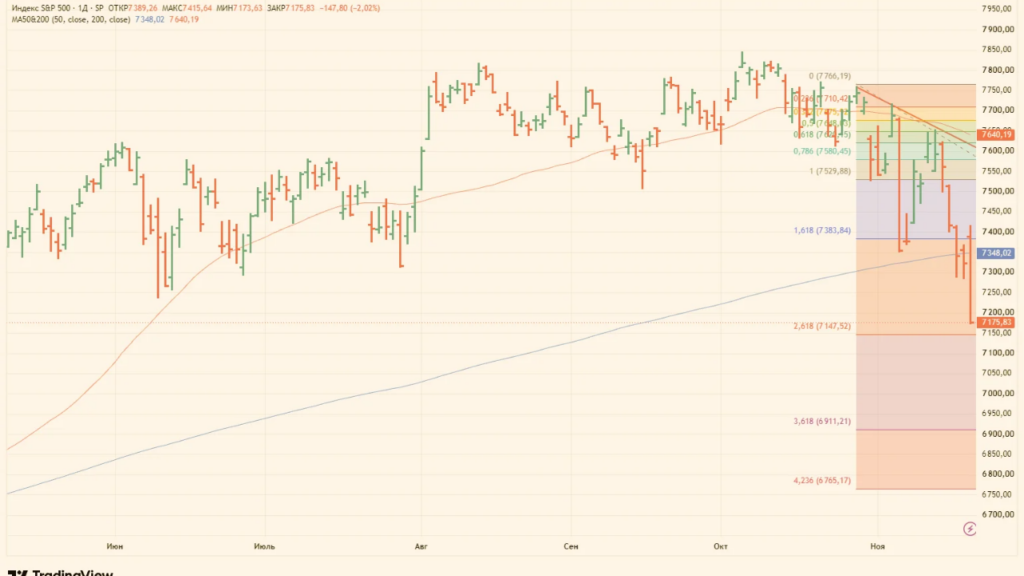
The session’s most significant technical development was the S&P 500’s failed attempt to reclaim its 200-day moving average near 7,347. The index briefly climbed above 7,400 shortly after the opening bell but surrendered its gains and slipped back below this important technical threshold even before Anthropic began trading. Selling pressure intensified during the afternoon, leaving all three major indexes below their respective 200-day moving averages.
Anthropic (ANT 97.17, +14.17, +17.07%) made an impressive Wall Street debut, opening at $111.50 per share, approximately 34% above its $83 IPO price. Although the stock subsequently retreated from its opening level, it finished at $97.17, gaining 17.1% relative to the offering price. The successful listing demonstrated substantial investor appetite for direct exposure to generative AI, even as sentiment toward established technology companies continued to deteriorate.
However, enthusiasm surrounding Anthropic’s IPO failed to translate into sustained gains across the broader AI investment ecosystem. The market’s reaction closely resembled Wednesday’s reversal following NVIDIA’s better-than-expected earnings report, suggesting that investors remained reluctant to increase exposure to technology stocks despite encouraging company-specific developments.
Information technology (-1.9%) surrendered an early gain of nearly 3.0%. The PHLX Semiconductor Index followed an even more dramatic trajectory, reversing from an intraday advance approaching 5.0% to finish down 2.4%.
NVIDIA (NVDA 145.98, -4.98, -3.30%) declined another 3.3%, extending its recent slide despite strong quarterly results. Advanced Micro Devices (AMD 489.19, -40.95, -7.72%) suffered a steeper 7.7% loss following a cautious report from Hunterbrook raising questions about potential risks associated with U.S. semiconductor export restrictions and the company’s exposure to China. According to Bloomberg, AMD denied any wrongdoing. The allegations remain disputed, and their implications have not been established.
Communication services (-2.9%) also experienced a sharp reversal after leading the market during much of the morning. Alphabet (GOOG 271.02, -8.18, -2.93%) initially advanced approximately 4.0% but subsequently reversed course, finishing 2.9% lower. The turnaround illustrated the difficulty even financially strong technology companies faced in sustaining buying interest.
Consumer discretionary (-3.0%) was the weakest S&P 500 sector, reflecting broad selling across consumer-oriented companies. Williams-Sonoma (WSM 220.95, -39.14, -15.05%) plunged 15.1%, making it the worst-performing component of the index. The decline followed quarterly earnings that were largely consistent with expectations and management’s decision to maintain its full-year guidance, which apparently disappointed investors seeking a stronger outlook.
Walmart (WMT 126.04, -1.32, -1.04%) also finished lower despite raising its earnings forecast. The stock declined 1.0%, indicating that even improved corporate guidance was not necessarily sufficient to support share prices in the prevailing market environment.
Nevertheless, several technology companies demonstrated relative resilience. Palo Alto Networks (PANW 361.73, +21.81, +6.42%) surged 6.4% after reporting better-than-expected earnings and substantially raising its fiscal 2027 outlook. The company’s results benefited from accelerating demand for cybersecurity solutions, including technologies designed to protect increasingly complex AI infrastructure.
Data storage companies also attracted selective buying interest. Seagate Technology (STX 521.39, +5.49, +1.06%) gained 1.1%, while Western Digital (WDC 296.78, +8.59, +2.98%) advanced 3.0%. Their relative strength reflected expectations that expanding AI workloads would continue supporting demand for high-capacity storage systems.
Health care (-2.1%) remained under pressure as managed care companies extended their recent losses. UnitedHealth Group (UNH 330.37, -19.54, -5.58%) declined another 5.6%, contributing to the Dow Jones Industrial Average’s weakness. The stock’s substantial influence on the price-weighted index amplified the impact of its continued decline.
Energy (-0.7%) was the session’s best-performing sector on a relative basis, although it also finished in negative territory. Its comparatively modest loss offered little protection against the widespread selling elsewhere in the market.
Market breadth confirmed the severity of Thursday’s downturn. Declining stocks outnumbered advancing issues by more than five to one on the New York Stock Exchange and more than three to one on Nasdaq. Smaller companies were not spared, with both the Russell 2000 and S&P MidCap 400 falling 1.8%.
The widespread deterioration was particularly notable because the session began with substantial gains in technology and AI-related stocks. The inability to sustain those advances suggested that investors were using short-lived rallies to reduce exposure rather than establish new positions.
Thursday’s decline also reinforced the significance of the market’s weakening technical structure. The S&P 500’s failure to hold above its 200-day moving average, combined with similar weakness in the Nasdaq and Dow Jones Industrial Average, left all three benchmarks below a widely monitored indicator of their longer-term trends.
The contrasting performances of Anthropic, Palo Alto Networks, and major semiconductor companies illustrated the increasingly selective nature of investor demand. While enthusiasm for new AI technologies and cybersecurity remained evident, investors continued to question the valuations, competitive risks, and financial requirements associated with the broader AI investment cycle.
With losses spreading across all sectors and market capitalizations, Thursday’s failed rally left the market in a vulnerable position. The inability of NVIDIA’s strong earnings and Anthropic’s successful IPO to generate sustained buying interest suggests that a durable recovery will require more than positive company-specific news, particularly while the major indexes remain below their 200-day moving averages.
Our FTInvest 11 model portfolio declined 0.91% to close at 856.86, extending its losing streak to six consecutive sessions and establishing another new closing low for the current drawdown. Thursday’s decline followed Wednesday’s 1.99% drop, pushing the portfolio further below its previous September 30 correction low of 880.69. The index now stands approximately 21.8% below its all-time closing high of 1,096.33, remaining firmly in bear-market territory as measured by the commonly used 20% drawdown threshold. Since last Friday’s close of 923.01, FTInvest 11 has lost approximately 7.2%, reflecting the severity of the recent selling pressure.
Based on the start-of-year level of 928.18, FTInvest 11 is now down approximately 7.68% year-to-date, compared with a 6.84% decline at Wednesday’s close. The latest decline brings the portfolio’s November performance to approximately -8.37%, extending the reversal of October’s recovery. With the index now approximately 2.7% below its September correction low, the downward movement has continued without a positive trading session since November 11. Although Thursday’s percentage decline was smaller than those recorded earlier in the week, the persistent sequence of losses indicates that the recent selloff has yet to stabilize. FTInvest 11 remains substantially below its July record, with the broader downward trend continuing to dominate its performance.


