
News
Wall Street Recovers From Intraday Lows as Investors Rotate Away From Technology Stocks
Industrials (+0.8%) also staged a notable recovery as AI infrastructure companies pared their early losses. Deere & Company (DE 641.02, +27.26, +4.44%) advanced 4.4% following its earnings announcement, while Axon Enterprise (AXON 343.05, +23.73, +7.43%) climbed 7.4%, ranking among the session’s best-performing S&P 500 components.
Energy (+0.7%) extended Tuesday’s recovery, supported by another increase in crude oil prices. WTI futures rose $1.58, or 1.9%, to settle at $83.67 per barrel.
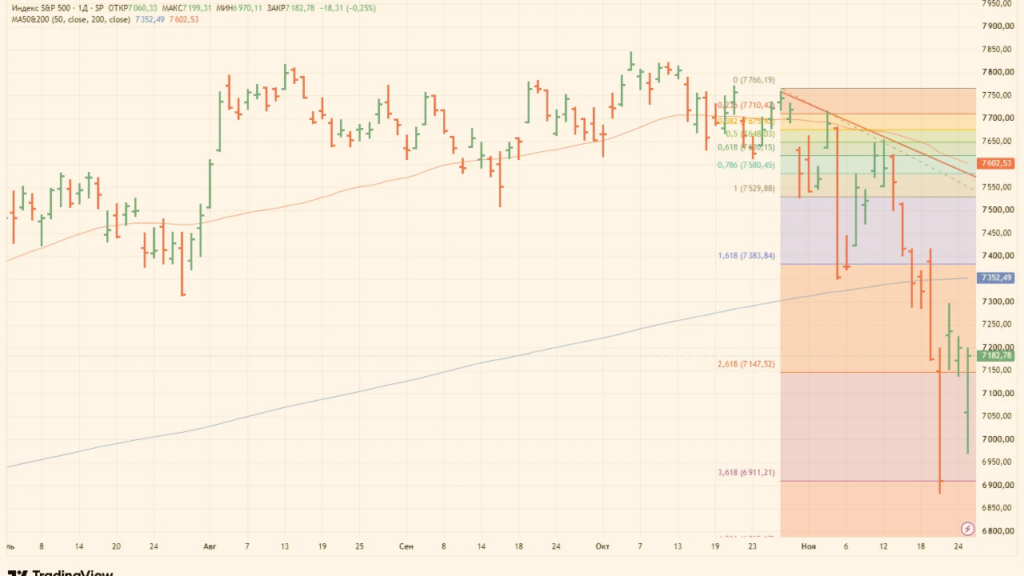
The improvement in market breadth was particularly evident in the performance of the S&P 500 Equal Weighted Index, which advanced 0.8% despite the decline in its capitalization-weighted counterpart. Smaller and medium-sized companies also demonstrated considerable resilience, with the Russell 2000 gaining 0.7% and the S&P MidCap 400 advancing 1.2%.
Although the major benchmarks still have considerable ground to recover following November’s selloff, Wednesday’s performance suggested that investors remain willing to seek opportunities outside the technology sector. Concerns about AI infrastructure financing, profitability, and elevated valuations continue to weigh on the market’s largest companies, encouraging a rotation toward other segments of the equity market.
Our FTinvest 11 model portfolio rebounded 1.93% to close at 839.20, recovering part of Tuesday’s sharp 2.89% decline, which had pushed the portfolio to a new closing low of 823.31. Wednesday’s recovery marked the second positive trading session this week, reflecting increased volatility following seven consecutive sessions of losses that ended on Monday. Despite the latest rebound, the index remains approximately 4.71% below its September 30 correction low of 880.69 and continues to trade firmly in bear-market territory, standing approximately 23.5% below its all-time closing high of 1,096.33. The latest gain provides some relief following the recent selloff but remains insufficient to reverse the broader downward trend.
FTinvest 11 is now down approximately 9.59% year-to-date, improving from an 11.30% loss at Tuesday’s close. Wednesday’s rebound also narrowed the portfolio’s November loss to approximately 10.26%, while its performance since last Friday’s close has turned modestly positive, with a gain of approximately 0.85%. Nevertheless, November’s substantial decline continues to more than offset October’s 6.18% recovery. The alternating pattern of gains and losses this week highlights the continued instability of the portfolio following the sustained selling pressure experienced earlier in the month. Although the latest rebound represents a partial recovery from Tuesday’s low, recent trading has yet to establish a sustained upward trend or provide convincing evidence of stabilization.
U.S. stock markets will remain closed on Thursday, November 26, in observance of Thanksgiving and will reopen on Friday for an abbreviated trading session.


